Sewing the Sail
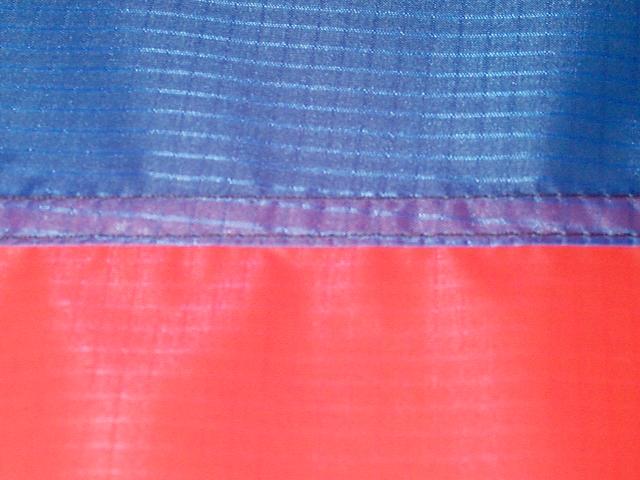 All of the seams on the Pizazz sail are flat fell seams. Simply put,
this means we lay two layers of cloth together back to back and sew down
the edge leaving a seam allowance. We then lay the two layers of
cloth out flat, roll the seam allowance under and stitch down the cloth
again. This gives us a seam similar in appearance to the seam down
the outside of a pair of jeans. All of my seam allowances are 1.5
cm and I use a 3 mm straight stitch. I had to switch kites as the
white and read weren't giving me sufficient contrast to show up against
the white background.
All of the seams on the Pizazz sail are flat fell seams. Simply put,
this means we lay two layers of cloth together back to back and sew down
the edge leaving a seam allowance. We then lay the two layers of
cloth out flat, roll the seam allowance under and stitch down the cloth
again. This gives us a seam similar in appearance to the seam down
the outside of a pair of jeans. All of my seam allowances are 1.5
cm and I use a 3 mm straight stitch. I had to switch kites as the
white and read weren't giving me sufficient contrast to show up against
the white background.
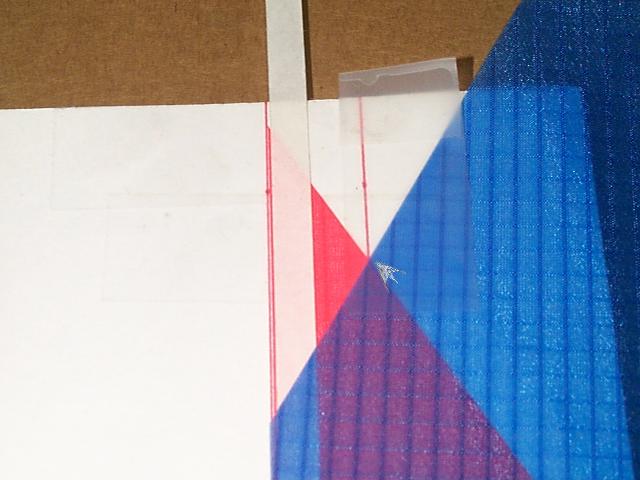 The seam allowance is the distance between the edge of the two pieces of
fabric and the line we intend on sewing. All pieces of the Pizazz
are cut to allow a 1.5 cm seam allowance. We will always sew the
cloth facing "back to back" Today we are going to sew the wing sections
together.
The seam allowance is the distance between the edge of the two pieces of
fabric and the line we intend on sewing. All pieces of the Pizazz
are cut to allow a 1.5 cm seam allowance. We will always sew the
cloth facing "back to back" Today we are going to sew the wing sections
together.
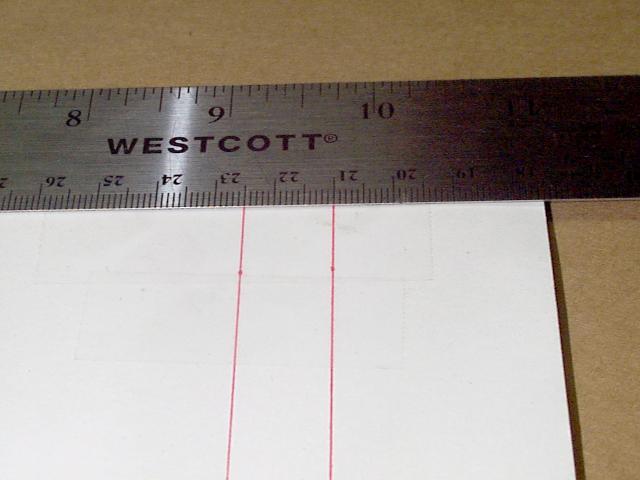 For
the completed wings to fit correctly to the center sail it is very important
that the individual wing panels be aligned correctly when sewn together.
The sharp angle of the wing panels makes this difficult. The edges
of the wing panels have to cross 1.5 cm from the edge of the fabric.
To aid in laying out the panels for sewing it helps to construct a set
of two parallel lines spaced 1.5 cm apart to act as a template .
For
the completed wings to fit correctly to the center sail it is very important
that the individual wing panels be aligned correctly when sewn together.
The sharp angle of the wing panels makes this difficult. The edges
of the wing panels have to cross 1.5 cm from the edge of the fabric.
To aid in laying out the panels for sewing it helps to construct a set
of two parallel lines spaced 1.5 cm apart to act as a template .
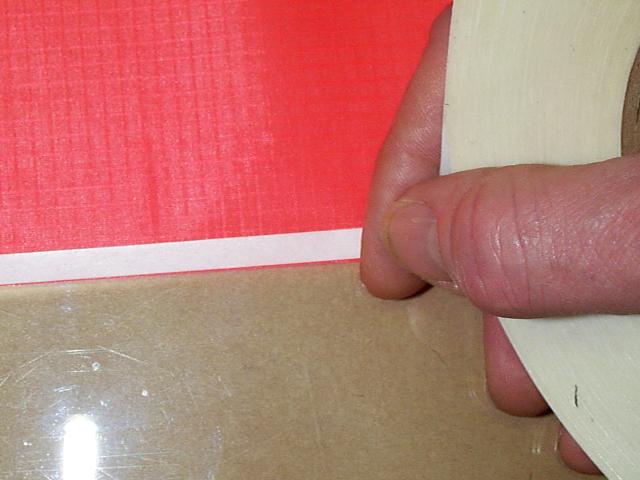 Start
assembling the wing by laying the lower wing panel face down on your working
surface. Then put a layer of seam stick down the top edge of the
panel. It is necessary to apply a slight amount of tension to the sail
panel to keep it straight as you put the tape on. I do this by laying
my hand against the sail as I pull the seam stick along. If you put
too much tension on the tape it will stretch the cloth and put a noticeable
bow in the edge of the cloth. Leave the paper backing on the tape
for now.
Start
assembling the wing by laying the lower wing panel face down on your working
surface. Then put a layer of seam stick down the top edge of the
panel. It is necessary to apply a slight amount of tension to the sail
panel to keep it straight as you put the tape on. I do this by laying
my hand against the sail as I pull the seam stick along. If you put
too much tension on the tape it will stretch the cloth and put a noticeable
bow in the edge of the cloth. Leave the paper backing on the tape
for now.
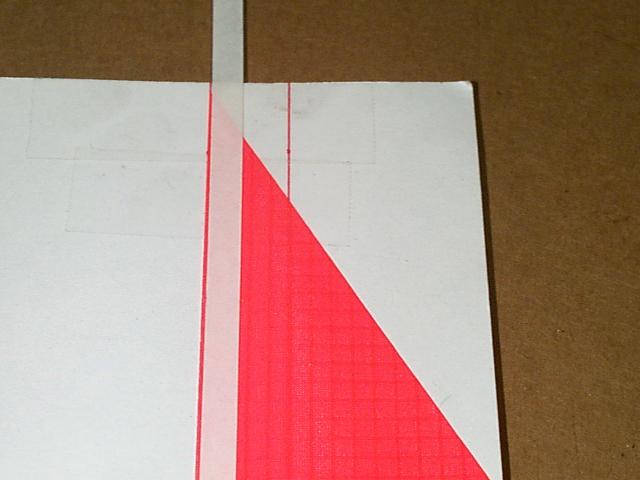 Once the lower wing panel is taped to the work surface I slide the 1.5
cm template under the cloth and align one line with the edge of the sail
piece. Tape the template down.
Once the lower wing panel is taped to the work surface I slide the 1.5
cm template under the cloth and align one line with the edge of the sail
piece. Tape the template down.
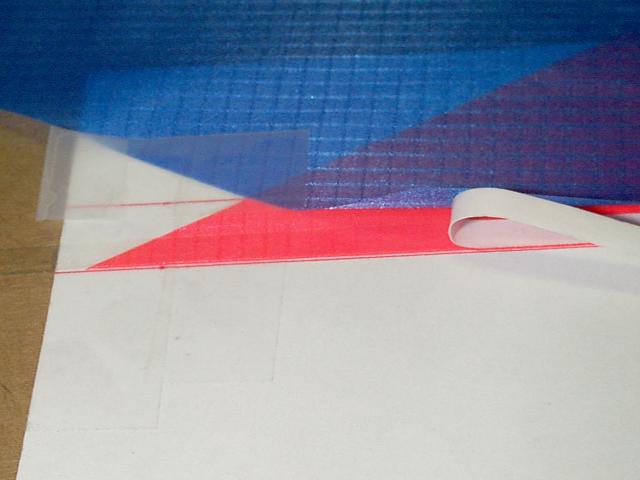
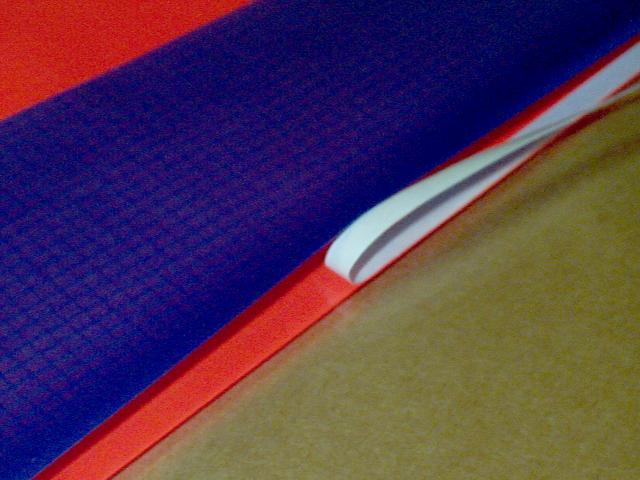
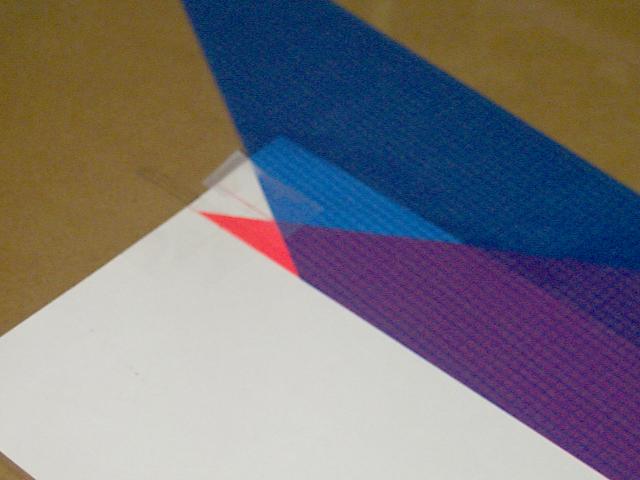
Lay the middle wing panel face up on top of the lower wing panel.
This gives us two layers of cloth, back to back. As long as the paper
is still on the seam stick we can slide the upper layer of cloth around
to get it properly in place. The lower edge of the middle (blue)
wing panel must lay directly on top of the upper edge of the lower (orange)
wing panel and the diagonally cut edges of the two panels should cross
at 1.5 cm (the second parallel line). See the picture. Tape the middle
wing panel in place at both ends with cellophane tape. I find that
masking tape sticks more than I'd like for this purpose.
With the middle wing panel taped down slowly remove the paper backing
to the seam stick by peeling it back from one end. I pull it straight
back along the tape to prevent moving either layer of cloth out of line.
The middle wing panel will fall down against the lower wing panel as the
paper backing is removed and should lay flat against the seam stick that
we put on the lower wing panel. Press the middle wing panel gently
in place and remove the cellophane tape. Then carefully peel the
seam stick and wing panels from the work surface and trim the ends.
Make the other wing panel at this time, making sure to make it opposite
of the first so you will have opposite wings. I'd hate to count the
number of kites I've started and wound up two left wings!
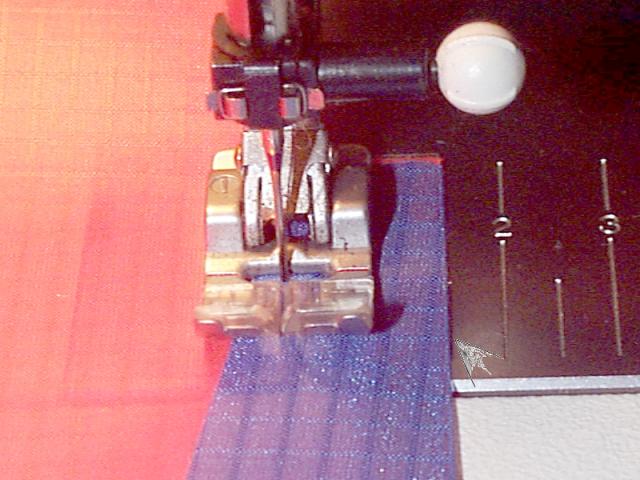 My sewing machine has guide lines along the right side of the sewing surface
measured in centimeters. If your machine has these guides measured
in inches you will want to measure out 1.5 cm from the needle and make
yourself a guide line there. Now we sew the length of the seam standing
off 1.5 cm from the edge. This allows us to sew the wing panels together
using seam stick to hold them while not sewing through all that tape.
I use a 3 mm long stitch on all of my seams.
My sewing machine has guide lines along the right side of the sewing surface
measured in centimeters. If your machine has these guides measured
in inches you will want to measure out 1.5 cm from the needle and make
yourself a guide line there. Now we sew the length of the seam standing
off 1.5 cm from the edge. This allows us to sew the wing panels together
using seam stick to hold them while not sewing through all that tape.
I use a 3 mm long stitch on all of my seams.
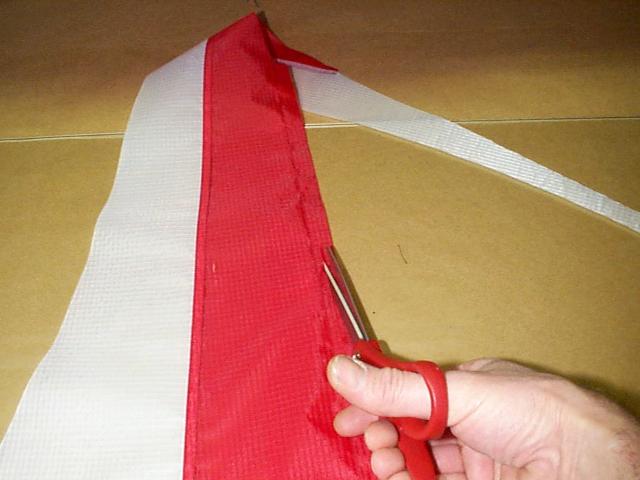
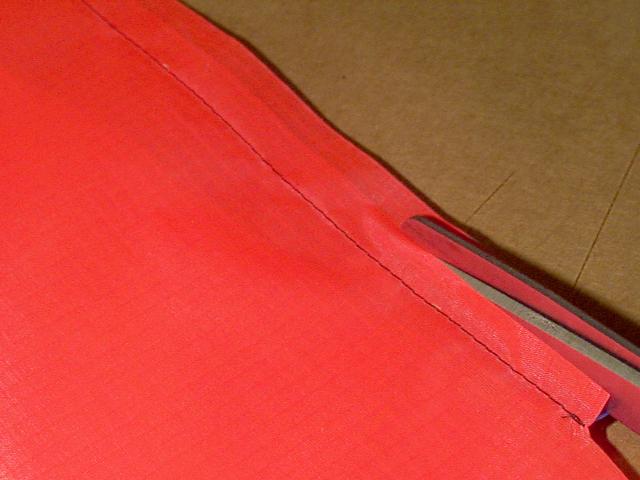 Once we have the two panels sewn together we trim away 1/2 of the seam
allowance on the lower wing panel. That way we are cutting away the
portion of the cloth that will be folded under as this seam will be rolled
down. If the middle wing panel was white (or a vented panel) I may
decide that I wanted to roll the seam up, as the white wouldn't cover up
the orange very well. If this were the case I would cut away 1/2
of the middle wing panel seam allowance. I hope that didn't confuse
anyone. This is not a critical measurement so I generally just slide
my scissors between the layers and slide them up the seam using the tape
as a guide.
Once we have the two panels sewn together we trim away 1/2 of the seam
allowance on the lower wing panel. That way we are cutting away the
portion of the cloth that will be folded under as this seam will be rolled
down. If the middle wing panel was white (or a vented panel) I may
decide that I wanted to roll the seam up, as the white wouldn't cover up
the orange very well. If this were the case I would cut away 1/2
of the middle wing panel seam allowance. I hope that didn't confuse
anyone. This is not a critical measurement so I generally just slide
my scissors between the layers and slide them up the seam using the tape
as a guide.
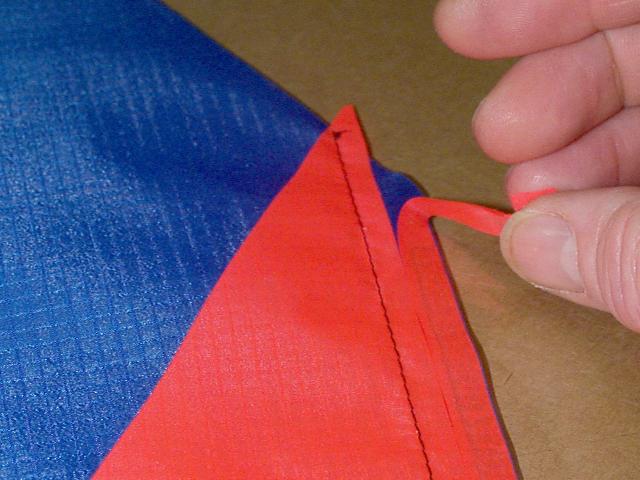
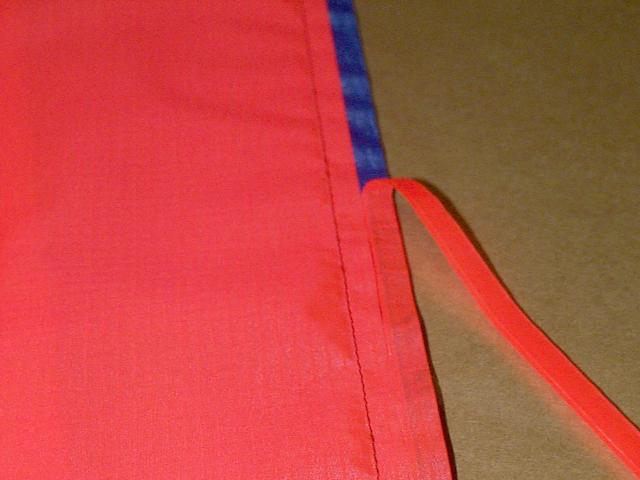
Once we have cut away the entire length of the seam we peel away the
excess cloth removing the seam stick with it.
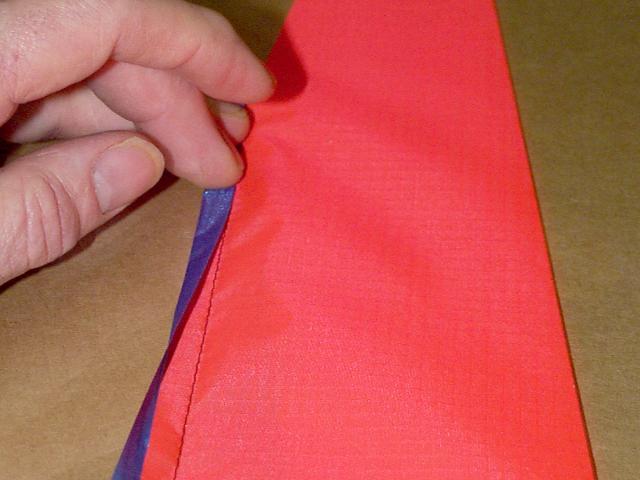 Now we fold the seam allowance from the middle wing panel over the lower
wing panel. The fold should take in 1/2 of the seam allowance so
the edge of the middle wing panel comes just to the seam. Fold the cloth
the entire length of the seam and crease the cloth at this fold.
Now we fold the seam allowance from the middle wing panel over the lower
wing panel. The fold should take in 1/2 of the seam allowance so
the edge of the middle wing panel comes just to the seam. Fold the cloth
the entire length of the seam and crease the cloth at this fold.
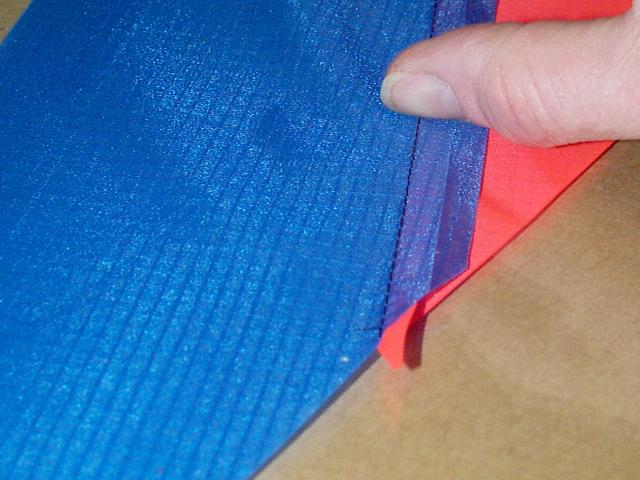 Next lay the wing panels out flat, face up. Pull the panels out flat and
crease along the seam. Make sure you don't have any of the lower
wing panel rolled under the middle wing panel.
Next lay the wing panels out flat, face up. Pull the panels out flat and
crease along the seam. Make sure you don't have any of the lower
wing panel rolled under the middle wing panel.
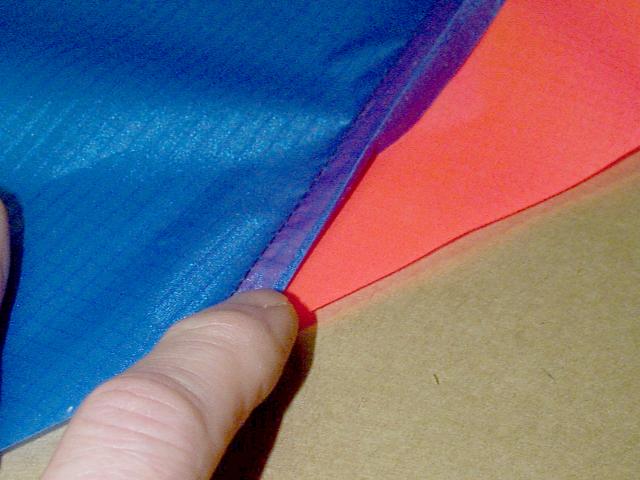
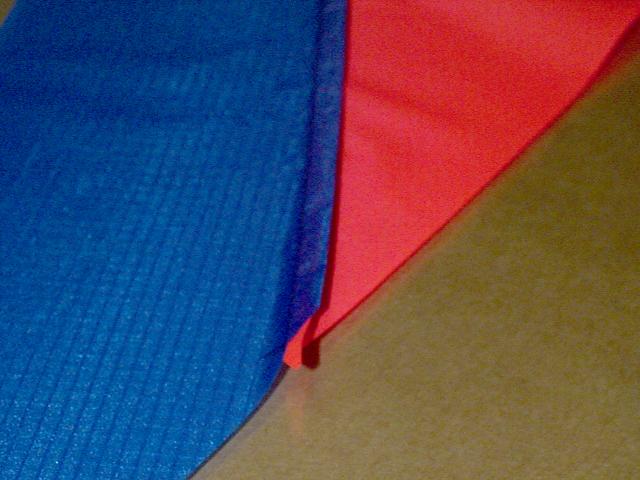 At this point you should be able to roll the seam under and have the entire
wing panel lay flat against your work surface.
At this point you should be able to roll the seam under and have the entire
wing panel lay flat against your work surface.
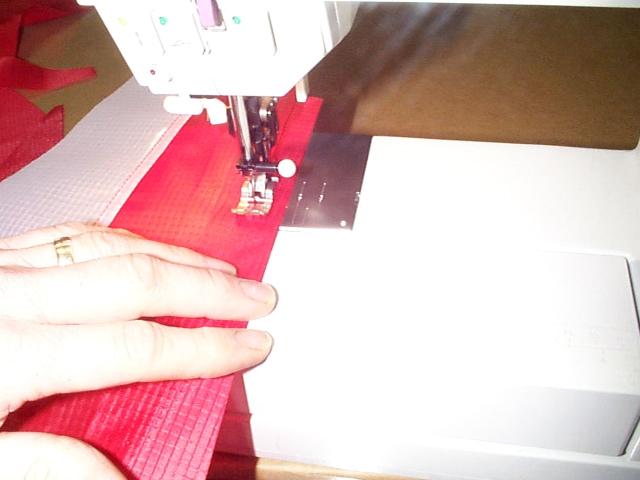
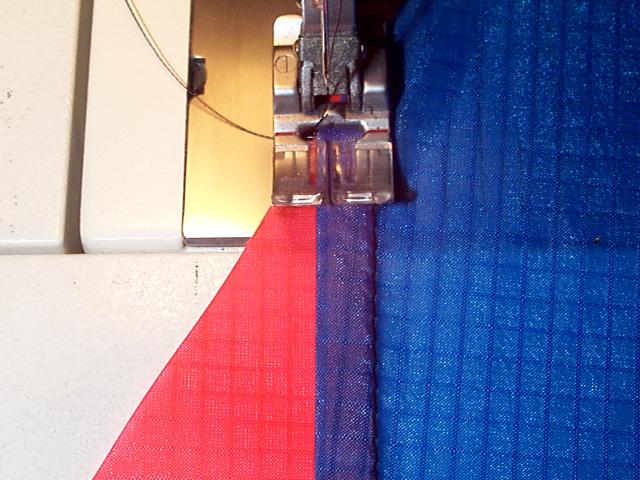 I sew the roll down with a straight stitch 1.5 mm from the edge.
To do this I'm using the center of the clear plastic on the left side of
my sewing foot as a guide. I'm pretty sure you will have to find
your own guide on your machine. As I sew down this seam I will just
make sure the fold stays under my mark.
I sew the roll down with a straight stitch 1.5 mm from the edge.
To do this I'm using the center of the clear plastic on the left side of
my sewing foot as a guide. I'm pretty sure you will have to find
your own guide on your machine. As I sew down this seam I will just
make sure the fold stays under my mark.
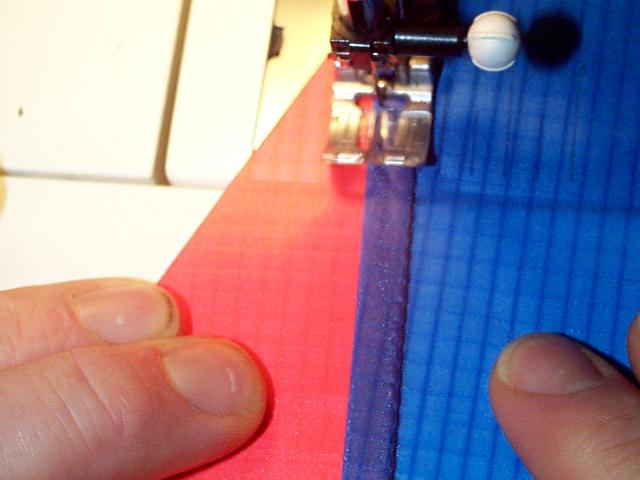 As I sew down the seam it is necessary to apply a slight outward pressure
on both sides of the cloth to make sure none of the sail gets tucked under
the seam. I normally sew 4 - 5 cm before I have to stop and tuck the fold
under again.
As I sew down the seam it is necessary to apply a slight outward pressure
on both sides of the cloth to make sure none of the sail gets tucked under
the seam. I normally sew 4 - 5 cm before I have to stop and tuck the fold
under again.
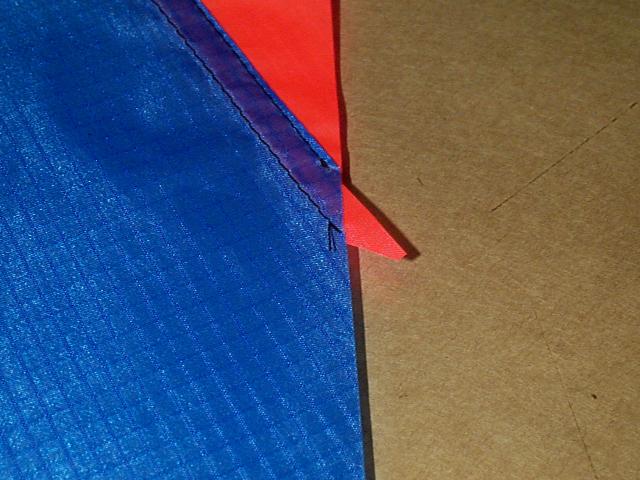 When the seam is entirely sewn we should have a wing piece that looks similar
to this. This is the end of the wing section that should be aligned
correctly as it will be sewn to the center sail. The closer to straight
we get this end the better off we are. Due to fabric stretch and the slight
errors we get in cutting the sail pieces the other end will not match exactly.
When the seam is entirely sewn we should have a wing piece that looks similar
to this. This is the end of the wing section that should be aligned
correctly as it will be sewn to the center sail. The closer to straight
we get this end the better off we are. Due to fabric stretch and the slight
errors we get in cutting the sail pieces the other end will not match exactly.
We'll get some more of this up tomorrow, time for dinner..
Sorry about the long delay between chapters.
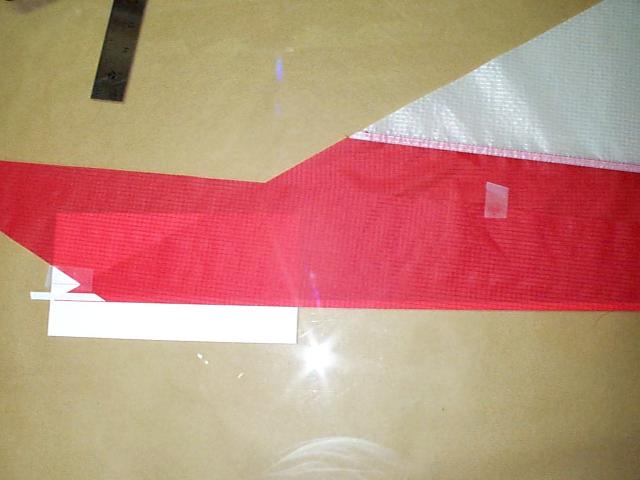
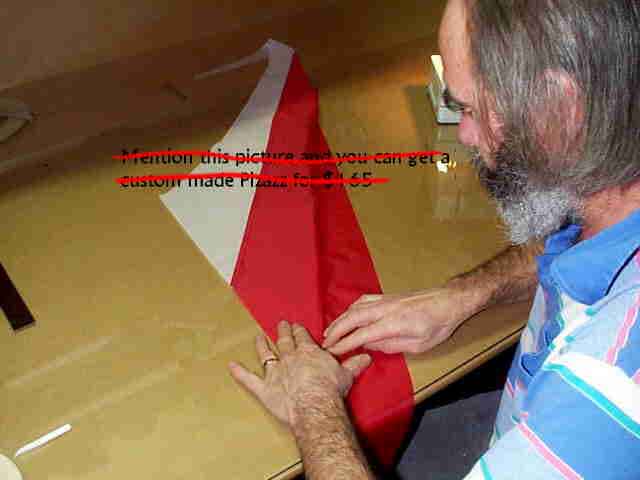
In similar fashion continue aligning the sail pieces. Lay the
lower two wing panels face down on the surface and put seam stick on the
back of the panel. Place the upper wing section on top of the lower
two face up. Then sew, cut away, fold and finish the seam.
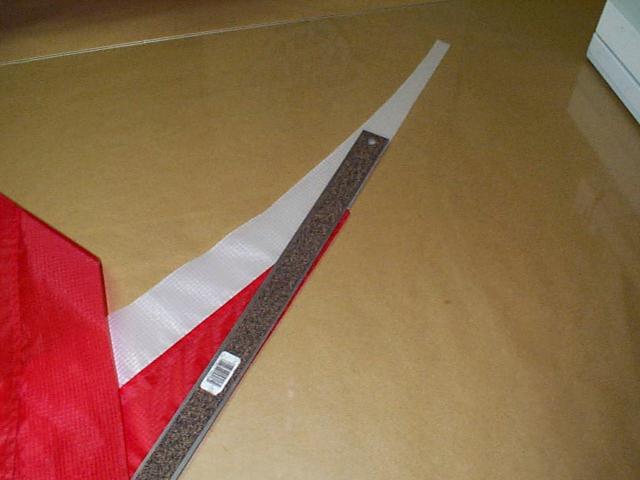 The templates for the wing have a built in error, hence so do the wing
sections. We will correct this error now. The middle wing section
is longer than the lower wing section and this will be noticeable at the
wing tip. Lay a straight edge along the leading edge of the wing
from the top of the lower wing section to the bottom of the upper wing
section. You will notice a small amount of cloth extending beyond
the straight edge. Cut this off using a razor blade or hot knife.
This should be a straight cut making a smooth edge between the upper and
lower wing sections.
The templates for the wing have a built in error, hence so do the wing
sections. We will correct this error now. The middle wing section
is longer than the lower wing section and this will be noticeable at the
wing tip. Lay a straight edge along the leading edge of the wing
from the top of the lower wing section to the bottom of the upper wing
section. You will notice a small amount of cloth extending beyond
the straight edge. Cut this off using a razor blade or hot knife.
This should be a straight cut making a smooth edge between the upper and
lower wing sections.
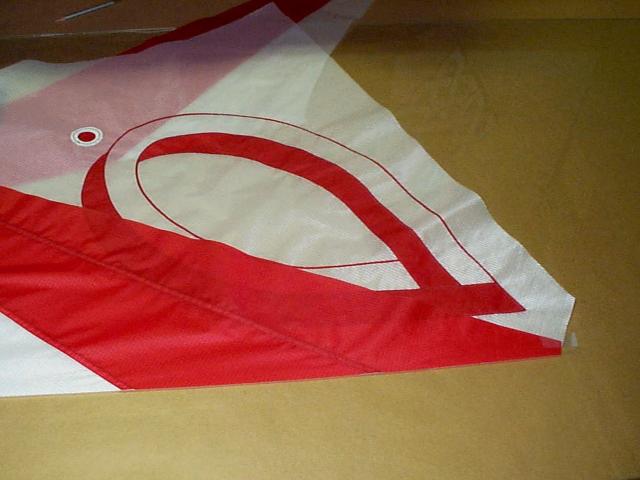
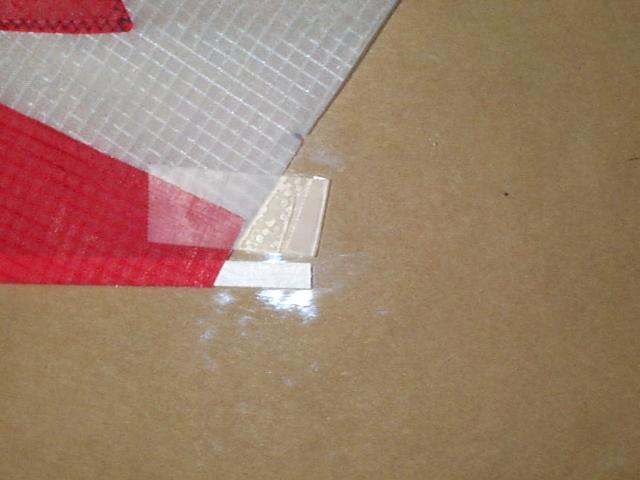
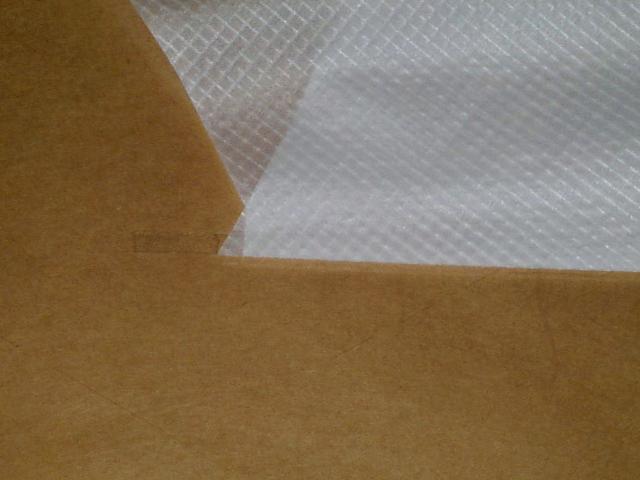
Once both wing pieces are assembled lay the center sail face down on
the working surface and apply seam stick to the edge. Next place
the wing on the center sail face up. The three images above show
the proper alignment of the wing sections. Again, due to minor sewing
errors the wing panels may not align properly. If everything is correct
the upper tip of the wing should cross the top of the center sail as shown
in the center picture. The bottom of the wing should cross the lower
portion of the center sail as shown in the picture on the right.
If this doesn't happen, don't worry too much. The important thing
is to align both wings on the center sail so they are even at the top of
the center sail. Leave any discrepancy at the bottom. Sew the
wings to the center sail just as we sewed the wing sections together.
Note here when you roll the seam between the center sail and wing section
you have two choices. One being to roll the seam toward the center,
the other being to roll the seam away from the center. There are
two considerations here. If you have a lighter colored center sail
than wing the seam doesn't look as good rolled out. The second consideration,
believe it or not, is it affects the way the kite flies. Rolling
the seam toward the center sail gives the kite a little more stability
and flies a little more precisely. That has to do with the position
of the standoffs. We will discuss that later.
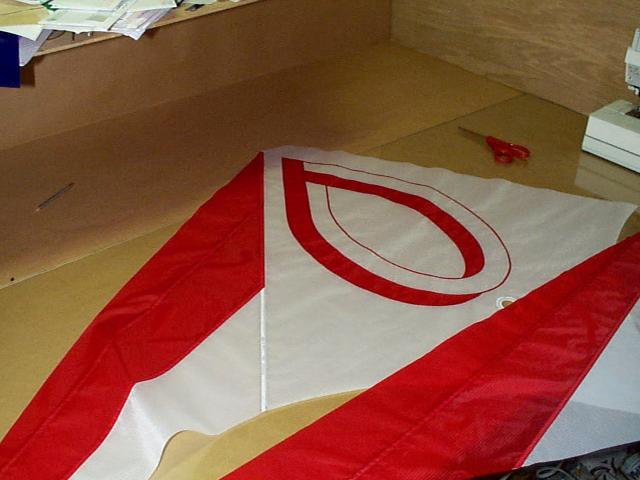 Once you have the wing section sewn on it should look like this.
If the bottom of the seam doesn't match exactly, trim the excess off in
a smooth curve. Sew the other wing on and we have the sail completed
and are ready for the leading edge.
Once you have the wing section sewn on it should look like this.
If the bottom of the seam doesn't match exactly, trim the excess off in
a smooth curve. Sew the other wing on and we have the sail completed
and are ready for the leading edge.