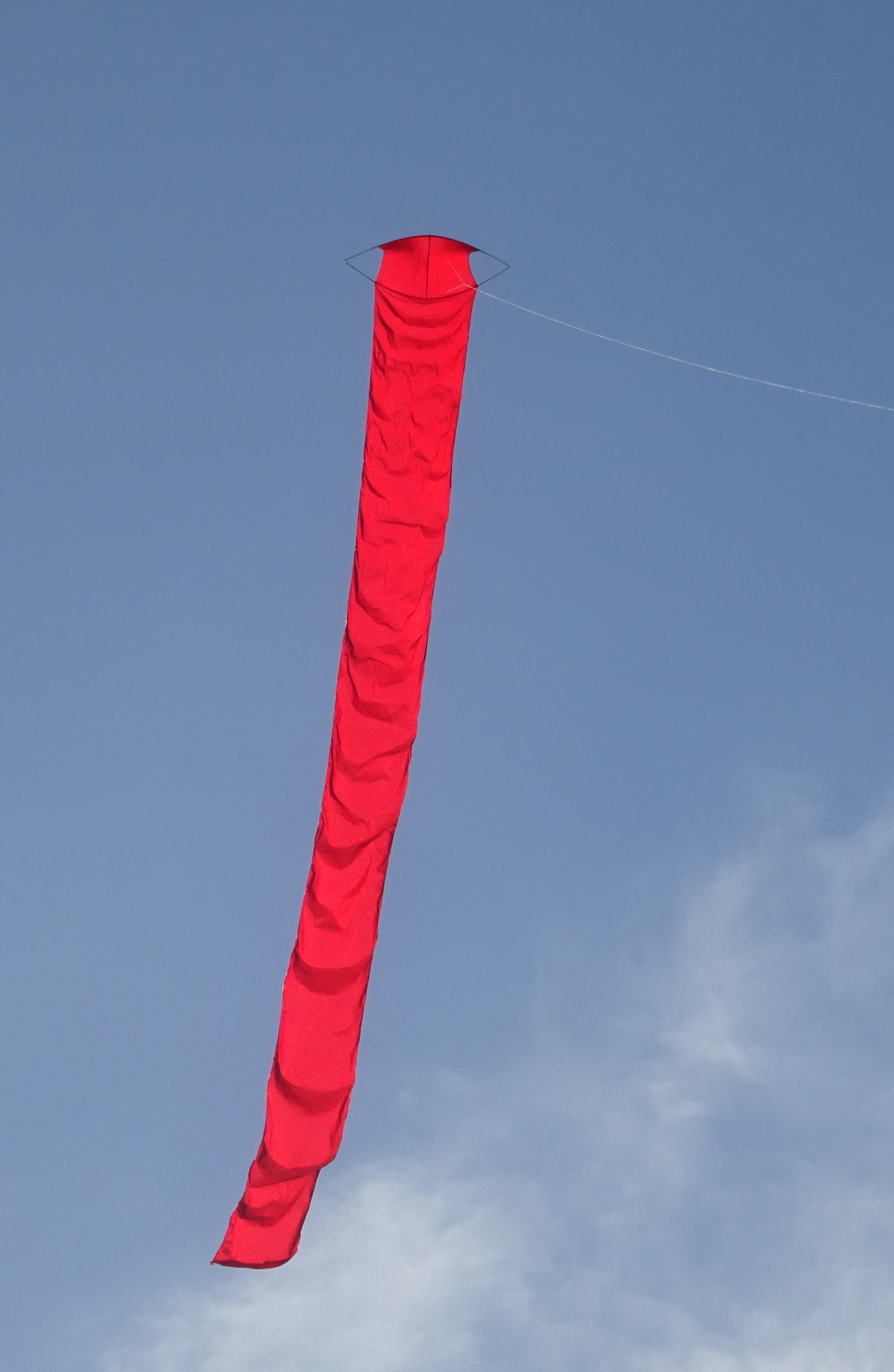
YangTze
Bali has the strongest kite culture in the world with several unique kites, one of them is the Janggan which has a tail that usually is 20 times the wingspan. Janggans with wingspans of 3 - 5 m are considered medium size; an 8 m Janggan is large and has thus a 160 m long tail. However, it is not only the length of the tail that is remarkable: it is also the rippling movement of the tail, like waves flowing from the wings down to the end of the tail.
A few years ago we, an Australian kite friend visiting Bali and me, talked about how to use the Janggan kind of tail, with the rippling effect, in a western style kite.The idea challenged me: I wanted to make a kite where the lifting part is as invisible as possible (in contrast to the Janggan where the lifting part is very elaborated, especially the head that is richly decorated).
It took me half a year before the solution dawned on me: A simple vented wing where the sail continues directly as the tail. The Eye Phi (Eye Φ) frame was born, see below.
The name YangTze is both a hommage to the origin (Janggan) and a reference to the Chinese river for the riverlike flow of the tail.
Andreas Ågren
 YangTze 15m building description
YangTze 30m building description
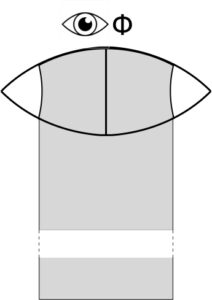
Eye Phi
Eye Phi is the actual kite part, the lifting part, of the kite YangTze.
In the PDF file there is a principle sketch of the Eye Phi frame.
Andreas Ågren