Materials for inflatable bladders
by Stelios Alex.Latest update: February 3rd 2003
Why are materials so important for making inflatable bladders?
If you want to make a good inflatable bladder, you have to find the right material for the job. Anything else just won't do! If you spend all your time and effort to find out that the material you used had hundreds of small holes in it, you will at least be frustrated and give up (at least for a while). Trust me, it has happened to me more than once...So before you grab your soldering iron or whatever tool you might have,
spend a minute and have a look at this list.
I have assembled all the info I could find on the net, specially in
group Foildesign (http://groups.yahoo.com/group/foildesign),
since there are so many people trying to make their own inflatable bladders.
Furthermore, I have tried most of these materials myself, that is why I
dare write comments on them.
How to weld?
There are many different ways to weld plastics. Some of them are only applicable to certain types of plastics.A few types of welding used in the industry are:
- Heat welding
- Supersonic welding
- Microwave welding (RF welding)
The most common method used amongst home-builders is heat welding.
You can do it with a sealing machine (expensive because the machine costs
a lot if you can't build it yourself), or a soldering
iron and paper tape (or cookie paper or No-Stick oven foil) or your
mother's flatiron.
What you should know is that different plastics do not stick together.
You cannot heat weld PE to PP. Neither PU to PE.
If you want to do this you have to use some kind of adhesive which
bonds with them mechanicaly, but it still is a very bad choice.
I use Black Rubber Adhesive by Loctite, or Neoprene cement (which is black
and sticky,too) to stick PVC valves on PP bladders. This adhesive works
well for sealing small holes on them, too.
Construction without welding, using glue/solvent
You can glue materials instead of welding them. PolyUrethane (PU) and PolyVinylChloride (PVC) can be glued instead of welded.The downside of glueing is that you can't get the accuracy achieved by heat-sealing equipment. Glueing is great for repairs, but when long seams are needed you have to be really careful not to use too much or too little glue.
Above all, you have to find the right glue! Be very careful when testing
glues for PVC because all of them contain acetone. Acetone is a solvent.
If the glue has too much acetone then it will melt it! The best choice
is usually those glues used for children's inflatable armband/toy repairs.
By The Way: Grey PVC adhesive (used for pipes) doesn't work.It has
too much acetone and many fillers.
Construction with minimal glueing/welding
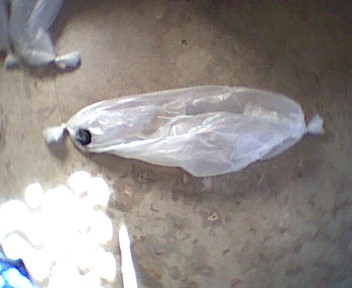
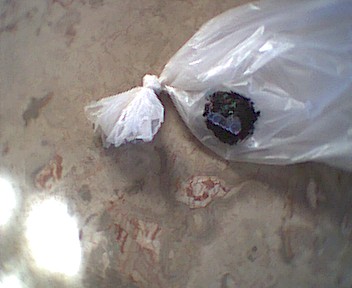
This is a typical polypropylene (PP) bladder with a PVC toy valve.
It is made from a carpet bag and its construction is as simple as that:
Tie two knots, one at each end of the bag. Then open a hole and put
the valve inside. Glue it in place. Put it in the kite and test!
Usually these bladders hold pressure really well, until some small
hole appears in them :(. PP is NOT glueable, so you can only use rubber
adhesive and pray it works (it usually does).
| Material | Air-permeability | Elasticity | Quality of Weld | Weight | Gluable | Cost | Comments |
| PolyUrethane (PU) | Very good. No air leaks from it. | Good | Very good. | Very light. | Yes | Most expensive by far | This is the stuff used in commercial inflatos. Costs a lot but you get what you pay for! Kind of difficult to find. |
| PolyEthylene
(PE) |
Lots of small holes appear after a few inflations. | Low | Not so good. Holes often appear on the seams. | Depends. You need something thick enough to withstand high pressure | No | Dirt cheap | Two types available: LDPE and HDPE. In some countries (like Greece) these materials cannot be used for bladders as they have too many holes. In other countries (like the Netherlands) I know people use it. |
| PolyPropylene (PP) | Very good. Fully inflated it feels like balloon material. | Better than PE. | Very good. | Usually you can use lighter sheets than PE because of its elasticity. | No | Cheap | Found in clothes or carpet bags and luxurious shopping bags. |
| PolyVinylChloride
(PVC) |
Very good. | Good but not as good as PU or Nylon | Best quality achieved with microwave welding. | Kind of heavy. Also depends on the material thickness. But this is the standard for the inflatable toys industry. | Yes | Not as cheap as PP | Kitchen tablecloth material, pond liner. This material is the only
compatible with valves from kiddies inflatable toys.
Can be glued instead of heat welded. |
| Vacuum
bagging film (Nylon) |
Very good. | Very good. Does not puncture but rather deforms. | Very good. The film is very thin and does not fray easily. | Light. | No | Cheaper than PU but more expensive than all the others. | Some say it is PolyUrethane.What I could get from my composites shop was Nylon. |
| Mylar | Very good | No elasticity. Once it starts to tear, it doesn't stop... | Very good. | The lightest by far | ? (probably not) | ? | This is the typical helium balloon material.
Thanks to Johan Van Eeckhout's experiments, I have seen some bladders made from this. Yet to be seen in a kite. |
You should note that the quality of the seams depends heavily on the sealing equipment that you have. For example, if you have industrial equipment then you can probably weld anything without problems. Nevertheless, some of these materials are known for their defects.