Prusik Knot:
(Note: A Prusik is a Lark's head done twice, but it is NOT a Double Lark's. That is a different animal, described under Lark's Head).
This is the best knot to use to bridle a kite. This is the knot found on most stunt kite bridles. The beauty of using a Prusik knot on a bridle is that it can be alternately locked in place, or unlocked and easily slid to a new position for easy pitch adjustment of any kite. This is much easier than trying to loosen up a Lark's Head to try and slide a swivel or other connector along a bidle.
This is as good a place as any to deliver the The Swivel Lecture: Swivels are for things that spin. Hopefully, the kite in flight is not an object that spins.... Therefore it is not a good idea to use a swivel on the end of a flying line. The reason being that it is impossible to determine the condition of a swivel before flight, and it is a 'mission critical' item. If it fails, it generally means the loss of the kite.
Just a quick reminder about swivels: Swivels, even the good Sampo ball bearing swivels, are designed to be used in water, with water flowing thru them to cool and lubricate them. In the air, holding on to a turning piece of laundry, there is nothing to cool or lubricate the swivel. They should be oiled at each use, either before, during, or after.
Another good trick is to install swivels reversed (pointy end away from the wind) whenever possible. This reduces the amount of sand and dirt that gets ingested by the swivel.
The best way of mating flying line to kite is terminating the flying line in an Overhand Loop, Lark's heading that to a Knotted Loop that has been Prusik'ed to the bridle. It is much easier to determine the condition of the Knotted Loop than it is any swivel.
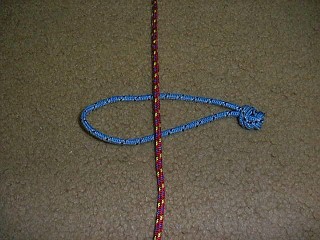
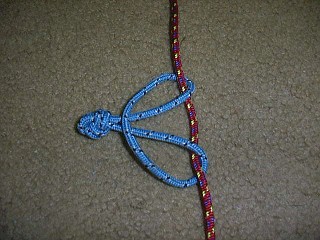
The Prusik starts off just like a Lark's Head. The blue line is a Kotted Loop and the red line would be the main bridle line of the kite.
Now go around the red line again.
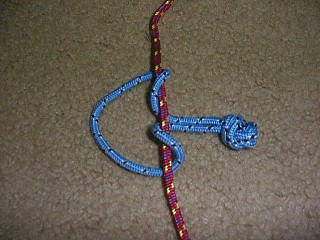
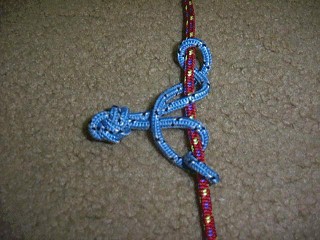
Around the line once is a Lark's Head. Around the line twice or
more is a Prusik.
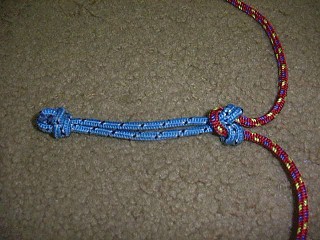
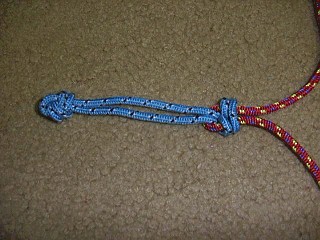
Pull it up tight, and even it out, and it should look like this: (front &
back)
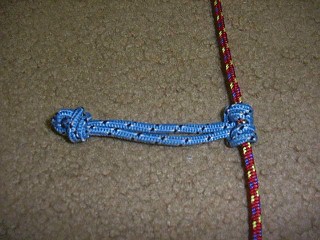
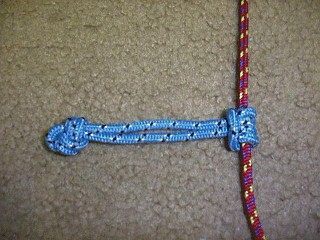
The pictures above show a Prusik in 'slide', or 'unlocked' position. Slide it to the appropriate position on the bridle, then 'lock' it by rolling it in the fingers. It is easiest to grasp it by pressing the Knotted Loop between pinky and palm, and pushing away with thumb and forefinger.
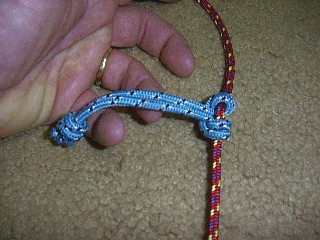
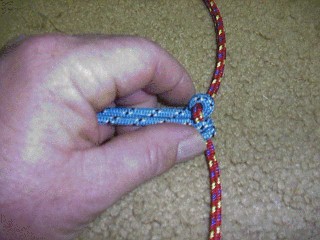
Okay, so now it is 'locked', and won't go anywhere. How to unlock it?
Grasp the line on either side of the Prusik and pull:
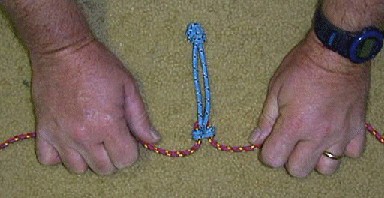
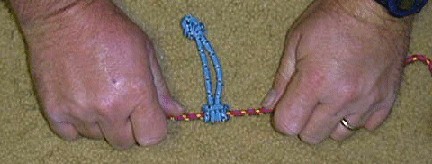
Isn't that easier than trying to pick loose a Lark's Head that has welded itself to a swivel connector or ring?
One last thing: A Prusik can be used for securing small items of line laundry to a flying line. Because of the tension on the flying line, a 'locked' Prusik cannot be acheived. It is best to go around the flying line several times. Again, only for light laundry, as strong pulling laundry will tend to climb the line, and may foul the kite.
I like to use the Prusik as the bottom knot when flying a Flag from a flying line. I use a Butterfly Loop to hold the top corner of the flag, but the bottom needs to be adjusted back and forth to get the 'pole' end of the flag vertical. It is not always easy to guess the final angle of the flying line, and a Prusik makes it easy to slide the bottom line back and forth to get the proper 'set' on the flag.