Welcome to the KITE KNOTS page:
The most commonly used knots for kite flying lines and bridles.
Flying kites involves working with string or line. Working with string or line involves working with knots. Knots are one of the basic skills essential to flying kites. They allow us to quickly and easily attach our flying line to our kites, laundry to our flying lines, and even our lines to our reels. Knowing when, where & why to use which knot, and how to tie it, can make kite flying very easy. These are the most commonly used knots in kite flying.
Alpabetically:
Big Kite
Bridle Knot - Great knot for 'large kite' bridles and internal
lines.
Butterfly Loop - Loop
in middle of flying line for laundry. Good for tying off to anchors, too.
Carabiner
Knot - For tying off big kites to an anchor
carbiner.
Double Fisherman's
Knot - Spectra Line can be tied! And this is how!
Double
Lark's Head - Useless except for Trlby owners. The
'anti-Prusik' knot.
Knotted
Loop - One of the best kept secrets in kiting. Easiest
way of joining lines to
kites.
No
Knot - Different from a
Splice,
a Splice that locks in place.
Overhand
Knot - Putting a loop in the end of a flying (or stack)
line to use far a Lark's Head later.
Lark's
Head - a 'must know' knot for any kite flyer. Most widely
used knot in kiting today.
Prusik
- The neat, adjustable part of a bridle. NOT a Double Lark's Head. Who's
obsessive?
Reel
Trick - the best way to secure the end of the flying line
on the reel after flying.
Splicing
- A great way to put a loop in the end of a line without a knot.
Swivel
Lecture - Why not to use a swivel in most places.
How to keep them happy where they must be used.
The knots every kite flyer should know by heart: Overhand Loop, Knotted Loop, Lark's Head, and its close relative, the Prusik.
Single line flyers should learn the Butterfly Loop to hang laundry on the line and to belay the flying line to an anchor. Note: When tying off to an anchor, always use an intermediate device such as a strap or carabiner. Never allow the flying line to fray from being tied to a staionary object.
Flyers wanting to join 2 lengths of Spectra will want to know the
Double Fisherman's
Knot,
This is a great loop to put in a flying line to hold line laundry. It is almost a 100% knot and is easy to untie after use, even if considerable tension has been applied to the line.
It is also useful for a loop to use to belay to an anchor, such as a strap and a carabiner. Always use an intermediate device (strap of some sort) to anchor a kite. Never tie off to a static object with the flying line. It will chafe and weaken.
Here is a link to an animated version of one way to tie it.
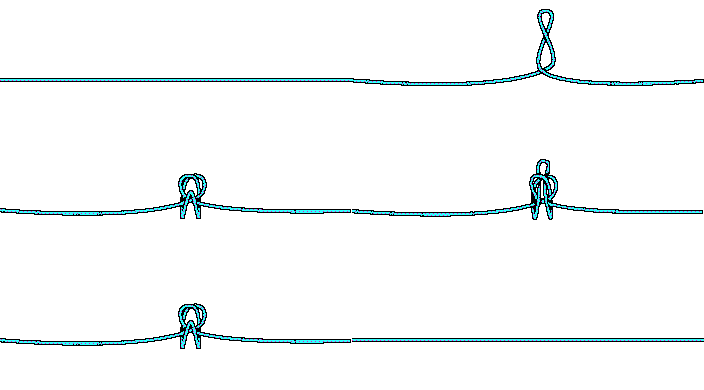
(animation credit UNE Mountaineering Club
http://www.une.edu.au/unemc/dbfish.htm)
I personally favor the finger method shown on the Roper's Knot Page, but I do it backwards from shown. I take the middle loop, put it under towards the knuckles, then it can be grasped with the fingers and pulled thru. You will need to scroll down a little on the Roper's Page:
Roper's Knot Pages - Single loops
This is THE knot to use to tie two pieces of Spectra together. It holds every time.
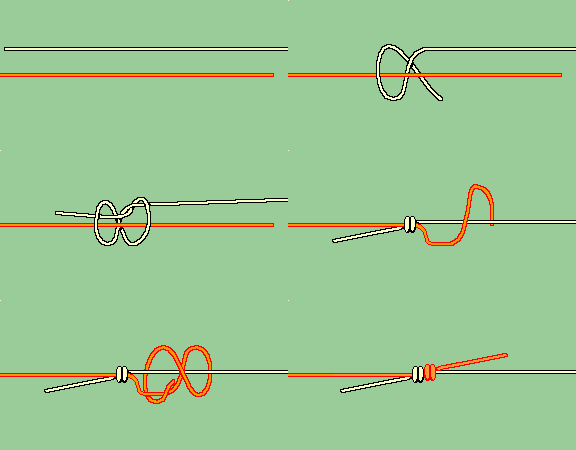
(animation credit: UNE Mountaineering Club
http://www.une.edu.au/unemc/dbfish.htm)
Now, tell me if this ain't the same knot:
http://brmrg.med.virginia.edu/knots/barrell.html
(Description to be built as AOL allows.... )
Perhaps one of the most dreaded aspects of flying kites is dealing with the line. One of the most frequently asked questions is: Don't those ever get tangled? The short answer is: Not if everything is treated well.
First Rule of avoiding tangles: Never, not ever, put a pile of string on the ground. Having said not to pile string on the ground, let's admit it; everyone does it. The trick is, once there is a pile of string on the ground, pick it up the same way it was put down.
Huh? What does that mean? The most common mistake is pulling in a kite hand over hand, putting a pile of string on the ground. So far, no problem. But then, people pick up their kite winder, and try to wind it up by pulling the string out from under the pile. That's how it gets tangled. To avoid the tangle, pick up the KITE end of the string from on top of the pile, and pile up the string all over again, pulling it from the KITE end. Now, the REEL end is the last part added to the pile, it is on top. That means reeling it in is pulling string off the top of the pile, instead of trying to slip it out from underneath.
Another way to avoid tangles is to maintain the flying line as 'un-twisted' as possible. Most braided nylon line is flat, so it is easy to see twists. Twists are tangles waiting to happen, so it is best to keep them out of the line as much as possible. Putting a swivel on the end of the line doesn't do this. Running the line out and winding back in a fashion that doesn't twist it does. Passing the line thru a carabiner helps remove the twists before the line reaches the winder. This is a great thing to do on a kite field on a no wind day. Run the line out, then sit with friends and chat while winding it back in.
On a bobbin or card type winder, use a Figure 8 wind to avoid twists. On Bill Sonntag Deep Sky winders, it is no problem, they wind from in front. Halo-type (ring) winders are the worst offenders for putting twists in the line. It is important when winding onto these winders to switch hands every so many turns. This way the line gets wrapped clockwise, then anti-clockwise, and the twists input to the line by winding cancel each other out.